Showing posts with label Book Talk. Show all posts

Thursday, January 22, 2015

Beyond the Laughing Sky, by Michelle Cuevas

The first thing I noticed about this lovely middle-grade book was its trend. Along with Nest, by Esther Ehrlich, Nightingale's Nest by Nikki Loftin, Under the Egg, by Laura Marx Fitzgerald, and others (but the foregoing three are ones I've read), this is about a child who either has a striking affinity for birds, might actually be part bird, or more than likely is a bird. This novel does a wonderful job of letting you know right from the start that you can expect fantasy. The first line reads: "Nashville and his family lived in a house perched in the branches of the largest pecan tree in the village of Goosepimple."

We learn early on that Nashville wasn't exactly born to his parents. He was hatched from the egg of a Nashville warbler that spilled from a nest outside his parents' window, and from the start he looked like a boy with a beak and feathers on his head in place of hair. Despite a sweet, supportive home with his parents and his younger sister, who came long in the usual way, Nashville wants most of all to have wings. He knows he belongs in the sky, he wants to fly, and the plot has to do with how he finds the way.

There are a lot of heartwarming moments. For example, though Nashville is teased at school sometimes, and tries to blend in (in one scene, he goes to the barber and has his feathers buzzed off), he also receives some touching acceptance and the beginnings of friendship from the boy he's afraid will be his nemesis. And there are humorous moments. Nashville volunteers at the local pet shop, and when he hatches a scheme to let the birds sample flying by tying them all to strings and holding them like a bunch of balloons, he causes a public sensation and is told by the store owner, "Nashville, you are absolutely, irrefutably, indubitably FIRED." There are more lovely lines, and here's a favorite: "At some point during the night, summer had left town, had packed a suitcase full of fireflies and swimming holes, and whistled on down the road."

The omniscient point of view is just right for this fantasy with a classic feel, and may remind more than one reader of Kate DiCamillo. While the message of being who you were born to be is a bit obvious, and I thought the POV faltered in a spot or two, overall this is a winner. Definitely recommended.

Thursday, December 18, 2014

The Swift Boys and Me, by Kody Keplinger

Nola, age 12, has been friends with the three Swift boys for her entire life. In fact, they live in the other half of the duplex. Brian, the oldest, is sensitive and kind. Kevin, the youngest, is constantly talking. And Canaan, the middle brother, is Nola's age, and he has always stood up for her.

Then one day, Mr. Swift gets in his car and drives away. He's left his family, without even a goodbye. Ironically, Nola saw him go, waved to him, and received a wave back, which, as she says, was more of a goodbye than the boys got.

And the Swifts fall apart. Kevin, who we find out blames himself because the last thing his father had told him to do was quit talking, goes mute. Brian tries to run the household for a while after their mother sinks into depression, but it's too much for him and in effect he runs away from home, staying first with one friend and then another. And Canaan takes up with the mean boys. Far from sticking up for Nola, he's now one of her tormentors.

Nola tries to support the boys, but succeeds only with Brian, and then only temporarily. She also tries to find their father -- mostly because she wants everything to go back to normal, which is no doubt realistic -- and actually does locate him living with another woman in the next town over. But Nola's life is changing, too. Her mom is remarrying, and the couple's plan to buy a house means Nola will have to move out of the duplex. And are the boys there for her? No, they are not.

My favorite aspect of the book is the characters. I liked Nola, the boys, her mom, the new stepdad, and Nola's other friends, Felicia and Teddy. We become disillusioned with Canaan, which I think is inevitable and probably the author's intent, not only because of how he's treating Nola, but because we come to suspect that Canaan's past bad-mouthing of Teddy was completely undeserved. In fact, now that Nola is less tied to Canaan, she is less dependent on his opinions and more able to stand up for herself.

The cover is a bit "cuter" than the novel itself, and does not portray Nola's slight overweight, which is often referred to in the story. (But as one of my editors once said, "That's marketing for you!") And it's possible that Nola understands everything just a bit too neatly at the end, although the plot threads are by no means tied up in a perfect bow. Recommended.

Thursday, December 4, 2014

Brown Girl Dreaming, by Jacqueline Woodson

Oh, my. This is a simply beautiful book. Books written in verse aren't for everyone, but I tend to like them because the emotion is concentrated and the language precise. I didn't say "verse novels," because this isn't a novel. It's a memoir.

I think most writer/bookworm types are naturally drawn to a book about how a writer grows. To view the writing through a wider lens, it's about a girl finding her voice and her purpose. It's also about encouragement: I as a reader find myself a bit breathless at the fact that Jacqueline Woodson said, and told herself, that she wanted to be a writer from a very young age, and she did it. Oh, how she did it. And to broaden the scope even more, it's very much about the African-American experience in the days of the struggle for civil rights and beyond.

There are surprising bits, such as Woodson's upbringing as a Jehovah's Witness, and gut-punching bits, such as her younger brother lying in bed at night, eating paint chips off the walls. There are arresting lines, such as "Even Salome intrigues us, her wish for a man's head / on a platter -- who could want this and live / to tell the story of that wanting?" and lines that raise ire, such as her mother's warning concerning storytelling: "If you lie, one day you'll steal." As a matter of fact, I don't reject that statement in general; I think lying is a form of stealing; it's theft of the truth. But the claim, even by writers (about which I have ranted in the past), that storytelling is lies just makes me all kinds of crazy. Tell that to Jesus or to Nathan the prophet.

Although I'd like to know what Jackie's siblings did with their lives as well, we don't find that out. However, the book cries out for photos and that cry is answered; they're included in the back.

There aren't many books, when it comes right down to it, that should become required reading; this is one of them. Highly, highly, highly recommended.

Thursday, October 16, 2014

Nest, by Esther Ehrlich

Naomi, eleven years old in 1972, loves birds so much that she's called "Chirp" by everyone who knows her. She shares a love of dancing with her mother, while her older sister, Rachel, relates better to their psychiatrist father's penchant for counseling, which he does even within their family, often with gently humorous results. At least, at first.

Early on, Chirp's mom is diagnosed with MS. She can't dance anymore, and with this loss her mental health declines even faster than her bodily health, to the point where she is eventually hospitalized for depression. At this point, I must say that my involvement in the book lay more with the mother than the MC. Because I imagined losing writing the way the mother lost dancing, and even though I know I could not make writing my identity the way the mother made dancing hers, it would still be hard at times not to do exactly that. On top of this, having a therapist husband didn't spare the mother at all, or even really help her any.

As Chirp goes through the absence of her mother, the acting out of her sister, and the misunderstanding of her well-meaning father who doesn't really get her, she becomes friends with Joey, a somewhat sketchy neighbor boy who in the opening scene is throwing rocks at poles. Joey has problems of his own at home, and the personal pain each one carries makes their friendship fragile, in part because Joey understands Chirp's situation from the start whereas she's mainly blind to his. The 1970s details were a pleasant trip back in time for me, but also a jolting reminder that back then issues such as child abuse and mental illness were both swept under the rug and less gently treated. One example of this is the matter-of-fact way that Chirp refers to her mother's place of confinement as the nuthouse.

This is a beautiful book, well written and with affecting emotions. While I don't really want to issue spoilers, I feel some obligation to point out that the book gets a lot harder, sadder, and darker before the story's through, and it could be a bit too much for a very sensitive middle-grader. Other than that, though, this is highly recommended.

Thursday, September 25, 2014

The 14 Fibs of Gregory K, by Greg Pincus

This is a realistic MG novel about math and writing. How could I not read it?

Gregory is a middle child. Not only that, he's the middle child math-hater in a family of math lovers. Really, math eaters, breathers, and sleepers, if you're looking at Gregory's father and his older brother Owen, who both won the famed "City Math" competition in their day, and who spend almost all of their time in an attic study devoted completely to math. Mom, whose feet are a bit more on terra firma, is an accountant. (Not the same thing, but to anybody who hates math, it probably is.) Kay, Gregory's younger sister, is just wicked smart, period.

Gregory loves to write, which he has not dared breathe a word of to anyone except his best friend, Kelly, who shares that love and who wants him to go to Author Camp with her in the summer. Especially since Kelly and her mom are moving away after the school year ends in a few short weeks and they won't see each other much anymore. Gregory promises they will go. Except he hasn't asked his parents, and he can't do that because they'll say no due to his current failing math score. In fact, his parents are going to make him go to Math is Magic Camp if he can't get his grade up. Continuing to fib to his parents about his love for math, because he can't bear to baldly state that he doesn't fit into his family, he recklessly declares that he's going to enter City Math himself.

In short, the key to Gregory's getting through all this is that he makes up a form of poetry he calls "Fibs." The poems contain 6 lines, a total of 20 syllables, and each line has a number of syllables equal to the first six Fibonacci Numbers: 1, 1, 2, 3, 5, 8. (In the Fibonacci Sequence, each number is equal to the sum of the previous two.) The Fibs begin each chapter and are sprinkled throughout, besides, and are delightful.

Gregory's math teacher is a really good character, and Gregory does have to work for his grade. However, I have this underlying feeling that, despite the great things that happen in the personal study program they devise, Gregory is really leaving 6th grade not knowing what he needs to know. And I'm not sure his teacher, in real life, wouldn't have to face some backlash. Kay, the younger sister, has some wildly precocious dialogue that I had to take with a grain of salt, and I found it odd that the reason for Kelly's move, when her mom already owns a thriving dessert restaurant right here, isn't explained.

But I loved the emphasis on math that won't bog a non-math reader down, the true kid appeal (these are genuine MG problems and stakes), and I loved this: Studies have shown that boys fall into one of four categories -- they're good at math, writing, both, or neither. Girls, however, fall into three categories -- they're good at writing, both, or neither. What this means is that if a girl is good at math, she's good at language, too. When I first read this research, I thought back through years and years of experience in math classes, and realized my experience fit the statement. Girls who had math talent also had language talent. Gregory is good at language/writing and not math. Kelly is good at both. Kay is good at both. Had the girls been good at math only, I wouldn't have been convinced by them. But for me, all three kids passed the test. :)

Thursday, September 11, 2014

Circa Now, by Amber McRee Turner

Someday, I'm getting a book cover this blue. Just saying.

Twelve-year-old Circa Monroe lives with her parents in a home whose most important room is Studio Monroe, where Mom runs her portrait photography business out of one half and Dad does his photo restoration work out of the other. Circa has a knack for intricate Photoshopping just as her dad does, and she had learned many techniques from him. But most important of all to Circa is the special file called "Shopt," consisting of just-for-fun Photoshopping weirdness and Dad's fun little stories to go along with the fantastical pictures. In creating this cozy, artsy, family atmosphere, Amber McRee Turner wastes no time at all making me want to live in Studio Monroe right now.

But that, as we know, is the status quo, and the status quo must change. When Dad heads out into a threatening tornado to deliver a restored photo to a particularly unpleasant family's reunion party, the worst happens. The tornado strikes the reunion site, and Dad is killed. Mom, whose depression and possible agoraphobia have been pretty well controlled by meds and the balance provided by Dad's presence, loses some of her functionality. This year, I have read no end of novels that are about dead parents and/or dysfunctional moms. I tossed some aside because it was just so much of the same that I was truly astonished. Not Circa Now. For one thing, the writing and turns of phrase are truly fresh. For another, the author makes me love the characters in the beginning, as "whole" selves, so that I care when they begin to falter. For yet another, the mother doesn't devolve so completely that she and Circa reverse roles. Besides all this, there is the mystery boy who appears at Studio Monroe out of nowhere, calling himself Miles and having lost his memory. And when random items that have been Shopt into photos start appearing or vanishing in real life -- e.g., a bird's nest appears in the tree outside Circa's window when Shopt into a picture, and a blemish falls off her friend's face when Shopt out of a portrait -- Circa has to wonder if maybe the reason they can't find Miles's home, and Miles can't find his memories, is that he doesn't have any -- because he himself was Shopt into existence.

Color me hooked.

This is one of those books where, even amid sad things happening, you want to be part of the characters' world. Add the good writing, the mystery, the light magical realism aspect, and the interspersed Shopt photos with attached stories (and the whole originality of that), and this book comes out a winner. Highly recommended.

Thursday, September 4, 2014

Another Book for our Critique Group

My long-time critique group has celebrated a lot of books over the years. Just a week ago we did it again, when Mary (second from right) brought her new book to our group meeting. Mary's Go Round is a self-published collection of all the short stories she has worked on since...well, since we've been a group. The physical book and its design are absolutely gorgeous, and it's filled with all of Mary's shiny, polished stories. With the release of this book, she has crossed a major item off her bucket list.

"I don't know what I'm going to write next," said Mary. "But I'll have to write something. You don't want me to leave you, do you?"

"No," the rest of us said, shaking our heads as one.

"Well, then I'll have to come up with something," she said. "What about family stories?"

"Yes!" we chorused.

So, we'll have to see what Mary has for us next time. Here we are, holding our autographed copies and our bubbly. Congratulations, Mary.

Thursday, July 17, 2014

Every Day After, by Laura Golden

It's the Depression, and Lizzie Hawkins's father has taught her to always be tough and never accept charity. The thing is, Lizzie's father wasn't so tough himself: After losing his job, he's taken off and abandoned his family. Her father's abandonment has in turn caused her mother's, only in a different form. Lizzie's mother is now completely catatonic.

Lizzie feeds the two of them by fishing and tending the vegetable garden. She puts her mom to bed at night and gets her up in the morning. She does the laundry (which procedure is described in detail) and fixes her mom cups of tea. She has always been a top student (another demand of her father's). But now her heavy responsibilities mean her grades are slipping, to the delight of her nemesis, a thoroughly mean girl named Erin Sawyer whose family has recently moved to Alabama from Georgia. Erin wants to be top dog above all else, and, among other unreasonable demands, continually harangues Lizzie to pull out of an essay contest they have both entered.

Lizzie is not completely likable, and that might be a stumbling block for some readers. Specifically, she is quite self-centered, and when her friend Ben confronts her about it, we root for him. But not only does the author keep many readers (judging by the love this book has gotten) rooting for Lizzie in spite of her rather blatant faults, but she manages, in first-person narration, to convey that Lizzie is a somewhat unreliable narrator. The characterization, setting, and writing itself are nicely done.

We keep hearing that the Depression era has been overdone in historical fiction, yet here it is again. I would probably read any number of Depression-era novels, and apparently I have lots of company. Minor quibbles: This is yet another mother/child role-reversal story, and I'm honestly full-up on those. Erin is allowed to be much brattier in front of adults than I believe a child of that era could have gotten away with. And I just didn't buy the name Erin. For an obviously Irish character that might have been okay, but Erin was a popular name in the 1970s and '80s, not in 1917, the approximate year of the MC's birth. But as I said, minor quibbles. This is highly recommended.

Thursday, June 19, 2014

Seeing Red, by Kathryn Erskine

Generations of Porters have been fixing cars in Stony Gap, Virginia, "ever since cars were born," as Red Porter's dad told him. His family's street is even called Porter's Shop Road. Red is twelve, but he's been changing oil on his own since he was nine, and Porter's Shop is everything Red loves: oil, gas, paint, brake pads, hoses, filters, Lava soap, old rags, "and a sink with a faucet you could turn on with just your elbow." Barely three pages into the book, I was completely invested in Red's being able to stay in that shop, on this land. Doing so will turn out to be almost impossible, of course, as Red's dad died of a heart attack just weeks earlier, there's no one to run the shop -- and at least part of the land might not even belong to the Porters.

Set in 1972, this rich, layered novel portrays a world in which civil rights and women's rights have barely awakened, and the Vietnam War fills the nightly news. The characters, major and minor, present and face difficult situations like child abuse, racial discrimination, and developmental disabilities. The pastor is a hypocrite. Red's early-childhood friendship with a black boy crumbles because of the pressures they face. Red is temporarily ensnared in a youth version of the KKK. His teacher, who is far from a hippie yet is teaching his class to "think," gets fired for not doing things the way they've always been done. Red, his younger brother, and his mom seem separated and scattered because they grieve in different ways. Worst of all, Red uncovers evidence that his great-great-great grandfather Porter, whose exact name he bears, shot a black man -- ancestor of an elderly woman he deeply admires -- in the back and stole his land. Red has always been proud of the Porter name. Now, he is not so sure.

There's enough plot here to keep the pages turning, and definitely enough impact and literary quality to make this an award contender, I think. This is a novel about small, gradual changes, and small, right choices, adding up to significant progress. While it may not be for the younger or sensitive reader (besides the other difficult subjects, the real-life lynching of Emmett Till is described in some detail), I otherwise highly recommend this.


Thursday, May 22, 2014

The Cranky Reader

Random things I've noticed about reading:

  • There are piles of books I love, and other piles I return to the library unfinished. When I was a kid, I read pretty much everything I picked up. No longer being able to do this is something of an occupational hazard of writing. 
  • Plots that hinge on failure to communicate need big-time, compelling, convincing motivation for that failure.
  • Presently, I'm really tired of contemporary novels with dysfunctional moms.
  • I'm in a plot phase. I want something happening that keeps me turning pages.
  • If I reach a point where I can't remember why I'm reading a particular book, it makes me feel like the characters and author are self-indulgent.
  • I love beautiful language and quotable lines.
  • I love compelling emotion and motivations I believe in my very bones.
  • I love an overarching and at least somewhat concrete goal that the MC must accomplish by story's end. When I'm a third or halfway through the book and have lost sight of this, I get antsy.
  • I love a lot of books, but I'm not blown away by many. The last MG novel that blew me away was Splendors and Glooms.
What have you noticed about reading lately?

Thursday, May 15, 2014

Nightingale's Nest, by Nikki Loftin

Twelve-year-old Little John feels responsible for his younger sister's death. They'd been climbing trees one day, and he jumped down, so she did too -- and was killed. Now, his depressed mother is losing her hold on reality, sometimes thinking her daughter is still alive. His father drinks too much. Money is so scarce that all luxuries (gaming system, cable TV) have been sold or dropped, and even making the rent is in question. Dad owns a tree removal service, and this summer LJ must work for him so that they can tackle a large job for the Emperor, so called because he is the rich owner of a string of dollar stores. LJ is only too happy to do so, because he feels that "every last murderous tree" in the world should be cut down. The first day on the job, though, he meets another little girl, about his sister's age at the time she died, who wants nothing more than to live in a tree and seems strangely able to do just that.

The book's first sentence sums up the story to a great degree: "When I first heard Gayle, I couldn't tell if she was a bird or a girl." Indeed, in this tale of magical realism, we are never sure. Her hair is soft as down, she "perches" and "hops like a wren," she's so light that possibly her bones are hollow. But the central story is Little John's, as he tries to dig himself out of a mountain of regret only to compound it. And when he faces a choice between betraying Gayle (as he, in a sense, betrayed his sister) or helping what's left of his family survive, he's facing a truly wrenching dilemma.

Based on Hans Christian Anderson's "The Nightingale," this is an emotionally affecting book with gorgeous writing, complex characters, a strong theme of forgiveness, and more richness than I can convey here. I would not be at all surprised if this novel becomes an award contender. While some readers may struggle with the sadness in the book, I never found it overwhelmingly gloomy, and it is balanced by the magic, and the ending. Highly recommended.

Thursday, May 1, 2014

Ice Dogs, by Terry Lynn Johnson

I know, I know -- it's May. Winter was long enough! But I just have to squeeze this one in.

Fourteen-year-old Victoria is one of Alaska's top junior mushers. She takes after her father, an award-winning musher who taught her everything she knows and who tragically died in a wilderness accident the previous year. Her mother, on the other hand, doesn't understand the love for dogsled racing.

So when Vicky qualifies for a big race, considers a new lead dog for her team, wants to look at the dogs her neighbor has for sale, and Mom turns thumbs down, Vicky hitches up six of her dogs and goes anyway. It's only thirty-five miles, and she'll be back by afternoon. Except she's hit by an unexpected blizzard. That, and she finds an injured boy about her age who has crashed his snowmobile. The extra passenger weighs her sled down,  knows zero about the wilderness (having just moved from a big city), and is unwanted company in any case, but in trying to bring him home she gets hopelessly lost. The rest of the plot follows the humans and dogs as they fight to survive the all-but-unsurvivable.

The emotional story progresses, too, as Vicky slowly discovers that a greenhorn city-slicker might have some value as a human being after all, comes face to face with the way her father died, connects with her dog team in an even deeper way than before, and begins to imagine and have compassion for what her mother is going through now that she, too, is missing in the Alaskan wilderness during a terrible storm. Victoria is a prickly, snarky character whom I didn't always like, but found fully believable. Definitely recommended, especially for readers who love action but prefer some depth along with it.

Thursday, April 10, 2014

What the Moon Said, by Gayle Rosengren

Set during the Great Depression -- an era we are often told is overdone in historical fiction -- this wonderful MG novel follows ten-year-old Esther from Chicago to a Wisconsin farm after her father loses his job in the city. From the beginning, it's filled with specific details that surround Esther and her sister as they make their way to a movie theater for a Rin Tin Tin matinee -- streetcars, a bread line, childhood games of the 1930s. But no details are as vivid to Esther as the signs her mother notices: a ring around the moon, dropping a spoon at supper, seeing a spider before breakfast, putting shoes on a table. All of these, and many more, foretell the good or bad luck that will befall their family, and Esther is proud that her mother learned so many important things back in Russia. Now, if only her mother would hug and kiss her. But Ma is a serious, even stern woman, and seems even more so toward Esther than her siblings. Wondering why she isn't loved as much as the others, Esther makes it her objective to please her mother so much that she'll win the affection she longs for.

It's this affecting goal that forms the through line of the story that follows Esther's adjustment from city to farm life. There are ups and downs, hard work and fun, until the day Ma "reads" a sign that Esther knows must be wrong. If she defies Ma she'll never gain her love, but can she be cruel to a new friend on Ma's say-so?

I loved the mother/daughter aspect of this story, the love of the family members that shows through despite the lesser physical affection true to the era, and the fact that Ma, as well as Esther, has to learn the hard way that not everything she thinks she knows is accurate. Heartwarming and beautifully written. Highly recommended.

Thursday, March 27, 2014

Below, by Meg McKinlay

This novel set in Australia has a wonderful beginning sentence: "The day that I was born, they drowned my town." The cover, first line, and premise form an almost irresistible triple hook. Twelve years ago, on the day of Cassie's premature birth, the mayor of her hometown, Old Lower Grange, flipped a lever and buried the town under 200 feet of water. The citizens celebrated the formation of this man-made lake from inside the borders of their new town, New Lower Grange, amid balloons and barbecue and a brass band. Except Cassie's parents, and their perfect two-child family, couldn't go. Because Cassie's parents were rushing to the hospital to have the baby who was doubly unexpected: Not only had they never intended a third child, but she was surprising them by coming way too soon.

Cassie's lungs were underdeveloped at birth, and her doctor requires her to swim six laps a day, every day, to exercise them. But the pool is always overcrowded, and Cassie is tired of people doing cannonballs on top of her when she's just trying to swim her laps. So one day she goes to the man-made lake. Not only is it fascinating because it's Lower Grange's own personal Atlantis, but because her family history lies there, a history that her parents and adult siblings made together that she, a late intruder into their lives, cannot share. Day after day, Cassie begins to swim in the lake, soon joined by Liam, a boy just enough older than she to have been born in Old Lower Grange, and whose family suffered a tragedy there. It doesn't take long before the kids realize the water level is sinking; the top of the fire lookout tree is now several feet above the surface. And then they start diving, and the mayor catches them, and gets way, way too upset. The rest of the plot is concerned with dredging up what the mayor's been trying to keep submerged.

I loved the language and writing style, especially since just prior to this book I'd tried to read another one that was so "loud and chatty" I had to put it down. Also, the midpoint of the plot is absolutely riveting. I had some quibble with the pacing though; I found it a bit slow to get underway and at the same time too rushed in the end. There was some symbolism that just kind of came and went. It's a short read, which in a sense I liked, but in another sense I'd like to have seen way, way more done with this material and these characters. All in all, I enjoyed it. Recommended.

Thursday, March 20, 2014

What's on the Nightstand

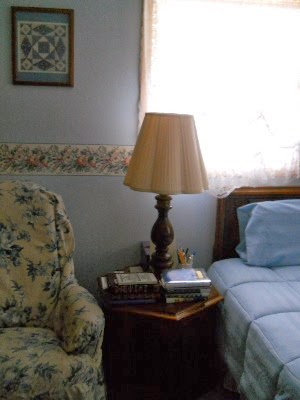
What a nice place to retire to in the evening.
My nightstand is actually not as overburdened with books as it once was. I've found that if the pile is high enough to teeter, I tend to give each book less chance before I give up on it. What that means, I've realized, is that a tall TBR pile, at least these days, represents pressure to me. Well, perish the thought! It's taken discipline, but I've decided to have fewer books here at any one time. All the better to savor each one. But what's on the pile? Let's get closer.
That's CS Lewis's Mere Christianity, the Thompson Chain Reference Bible, another Bible with a pretty cover and a compact size that's easy to carry, and my journal. While Mere Christianity isn't always there, the other three are constants on the nightstand. And on the other stack:
Which means I can try some spine poetry:

What the Moon Said
Ghosts at Tupelo Landing
Below
Ice Dogs

What's on your TBR pile?

Thursday, February 13, 2014

"Steer" Here for a Chance to Join this ARC Tour!


This contemporary MG novel is due out in May, 2014, from Abrams/Amulet. In Rebecca Petruck's debut, Steering Toward Normal, there is humor. There is heart. There's food for thought about what it means to be father and son, and what it means for 13yo Diggy to discover that one of his classmates just happens to be his half-brother. There's small-town, rural life, 4H, and the competitive raising of prize steers to show at the state fair, with a 12K purse at stake. There are plenty of April Fool's pranks. There may possibly be cow pies. 

I have had the fun of being involved in Rebecca's ARC tour. I got the ARC from MG writer Kim Van Sickler. Rebecca asked us to take a photo or make a short video with the ARC, and said that we get bonus points for involving a steer. Okay -- do you think this counts as "involving a steer"?


Now for the continued fun: the ARC needs to go to a new reader. Because state fairs figure prominently in the story, it would be great if the ARC could visit as many states (especially ones that have state fairs!) as possible. Here's all you have to do to get your chance to be next in line:
1. Comment below, using either the word "STEERING" or "NORMAL" in your comment.
2. You need to live in the US for this one (sorry).
3. Live in a state OTHER THAN: North Carolina, Ohio, and Wisconsin, seeing as how the ARC has already pranked toured these states.

That's all there is to it. So, comment away! Winner will be announced TUESDAY, February 18.

Thursday, February 6, 2014

Doll Bones, by Holly Black

I have to admit, when I first heard this was a book about a doll made out of the bones of a murdered girl, I wasn't interested. I believe I shuddered, actually. But curiosity, the fact that this is done for a MG audience, and Newbery buzz combined to make me pick it up. And I'm glad I did.

Zach, Poppy, and Alice have been friends forever, and even though they are now twelve, they continue to role-play with action figures to the point that their fantasy storyline has gotten very elaborate and absorbing. They are not just misfit kids who have no other friends, though. Zach, the POV character, is also an up-and-coming basketball player, growing up into a handsome kid (though he doesn't see this himself), and loves the sense of belonging he gets from his teammates. Zach's dad, who is suffering hurts of his own, decides that the time has come for Zach to put away childish things, and since Zach isn't inclined, he'll do it for him: He throws out all Zach's action figures. Zach, angry, embarrassed, and suspecting maybe he should be ashamed, refuses to tell the girls what happened. Instead, he turns his anger on them and tells them he can't play anymore. That's it. The end. Finis. It's when Poppy gets The Queen -- her mother's antique doll made of bone china -- out of its glass case in a dramatic attempt to get Zach to change his mind that ghostly things begin to happen. In short, the doll convinces the kids, particularly the loud and dramatic Poppy, that she is the bones and ash of a murdered girl, and unless they take her to her grave, where the rest of her remains are buried, she will make their lives miserable.

From there, they go on a road trip in an effort to accomplish the quest. I'm not going to detail the plot much more, to avoid spoilers, but this book is at heart a friendship story. Where the novel really shines is in its delineation of the relationships between all three kids and how each one is changing and fears change in the others. The adventurous plot is a wonderful vehicle for this exploration, and there are some great quotes such as the one by Zach's dad when they reconcile: "I thought you needed to be tougher. But I've been thinking that protecting somebody by hurting them before someone else gets the chance isn't the kind of protecting that anybody wants." I'm also fascinated by the history of bone china, which is touched on and may or may not have been the impetus for this story.

I had a couple of minor quibbles with the book. It absolutely turns on the fact that Zach wouldn't explain to his friends why he wouldn't play the game anymore, and I wasn't fully convinced he would keep that secret for as long as he did. And, for me, the quest portion bogged down a bit until it suddenly got irresistibly exciting. In fact, I came this close to putting the book down, but I'm really glad I didn't. A very good novel, worthy of its Newbery Honor.

Thursday, January 16, 2014

A Dog Called Homeless, by Sarah Lean

Cally's mother died in a car accident a year ago, and her father and older brother are dealing with their grief by packing away all the reminders and not speaking of their wife/mom. At school, Cally's mouth seems to always be open when it shouldn't be. Her best friend dumps her. When Cally begins to see visions of her mom in a red raincoat, accompanied by a large wolfhound who is not ghostly but real, she speaks up and says so. Dad gets angry and tells her he doesn't want to hear it; her aunt, more gently, tells her she's mistaken. Furthermore, Dad is putting their house on the market and moving the family to an apartment, and no amount of "please don't do this" makes any difference.

Then, at school, comes a charity fundraiser that involves volunteering to remain silent for 24 hours. When her ex-friend and other classmates jeer that Cally couldn't possibly keep her mouth shut, she volunteers. She completes the challenge with ease, and then, when the principal announces that the volunteers may speak again -- Callie doesn't. She realizes that she sees no reason. No one listens to her, anyway.

In the new apartment, Callie makes friends with a boy in the other flat who is blind, nearly deaf, and may have cerebral palsy or a similar condition. Though she doesn't speak, and in any event can speak to Sam only by spelling into his hand, the two grow into close companions. What the story seems to be saying here is that it's willing, listening hearts that really forge communication, not merely, or necessarily, the ability to speak.

Cally continues to see her mother's ghostly image, and the very real dog, which, while connected to her mother, is also being looked after by a homeless man, Jed. While everyone around Cally's family comes to believe that the dog belongs with them, to the point of telling her father so, he angrily insists they cannot take care of a dog.

We know that in the end they will, and that Cally will speak again, too. It's the emotional journey that's prominent here. I found myself rooting for Cally to not speak again until she was good and ready, and in that way this book tapped into powerful childhood emotions for me -- always a sign that I'll find that book a winner. Lovely and heartwarming. Recommended for anyone who would like a realistic story with overtones of magical realism.

Thursday, December 5, 2013

Flora and Ulysses, by Kate DiCamillo

It's hard to know where to begin with this one. Flora and Ulysses is a MG story that's part "regular" text and part graphic novel; part light and part serious; part fantasy and part realistic. It's funny and original.

It all begins the way superhero tales normally do: a freak accident endows somebody with superpowers. In this case, "somebody" is a squirrel who gets vacuumed up by an ultra-powerful vacuum cleaner, the Ulysses 2000X, and when resuscitated by the main character, Flora, has become a squirrel that has can lift large objects, understand English, and write poetry. Flora believes it's her mission to help the squirrel, whom she names Ulysses, to fulfill his destiny and vanquish his arch-nemesis. But what if his arch-nemesis turns out to be Flora's mother?

This book is filled with quirky characters, including Flora, who is a self-described cynic (which we learn is how she deals with the pain of her parents' divorce), both her parents, the neighbor lady who received the vacuum as a birthday gift from her husband, and the great-nephew she watches, a boy Flora's age who is temporarily blind due to family trauma of his own. Quirky isn't normally my taste, really, and you have to suspend disbelief to accept this many characters who are this quirky in one small geographical area (and two kids, ages ten and eleven, who can use such big words), but the good writing and the charm and the humor and the underlying poignancy drew me in and held me fast. You just might have to be Kate DiCamillo to pull this off, and she does. Recommended.

Thursday, November 21, 2013

A Tangle of Knots, by Lisa Graff

In this MG magical realism tale, most everybody has a Talent. It might be something useful and endearing, like Cady's talent, which is being able to look at a person and know what his or her perfect cake is, and then perfectly bake that cake. It might be something odd, like the ability to lick a hundred envelopes in eight seconds, or quite in keeping with what's expected of a boy who considers himself worthless, such as spitting with the accuracy of a sharp-shooter. Then there are those who don't have a talent, or haven't found it, who are called Fair, such as Marigold, who spends all her time trying one harebrained scheme after another in an attempt to find her Talent.

The book is itself a tangle of knots, and hard to summarize. It's about connections. It's about near-misses, and in that way reminds me of Lynne Rae Perkins's Criss-Cross. It's about a lot of disparate people and puzzle pieces coming together in the end, and in that way it reminds me of The Westing Game. I also think of it a bit as "The Penderwicks meets Savvy."

I saw a fair number of the plot twists coming; ditto which characters would turn out to be related and how. There are a lot of POV shifts, and at one point near the middle of the book I felt like I'd had one too many. But I cared about Cady, Zane, Marigold, and others, and wanted to find out how a dinosaur bone, a lost peanut butter recipe, a hot air balloon, an author who'd lost all verbal ability, a man in a gray suit with knots in his pockets, a place called The Lost Luggage Emporium, and more, would all come together. This novel, which is up for the National Book Award, is a fascinating puzzle that shows how a lot of different people and separate stories can converge at one moment in time.